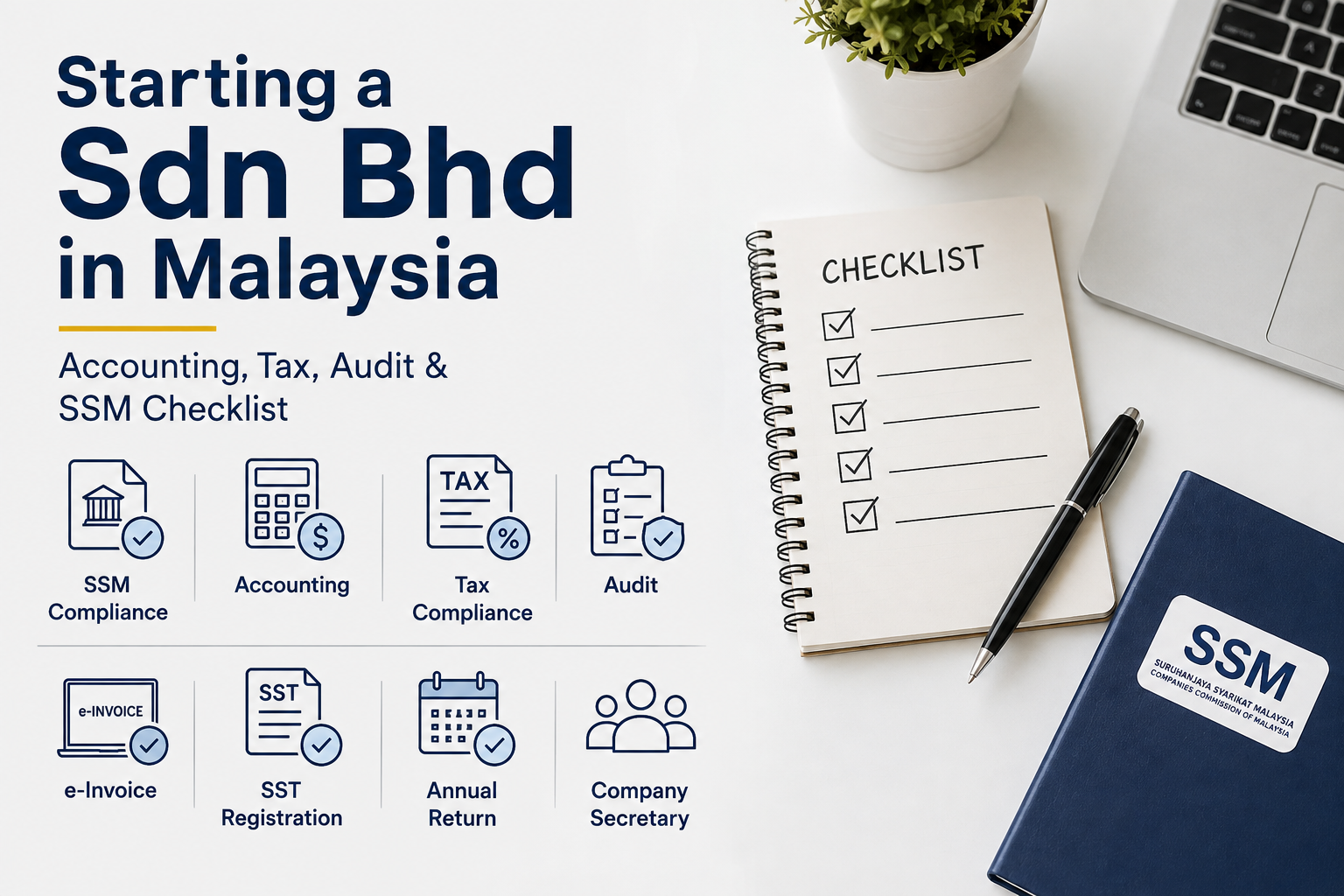
Starting a Sdn Bhd in Malaysia: Accounting, Tax, Audit & SSM Checklist 2026
Starting a Sdn Bhd in Malaysia is relatively straightforward. But incorporating the company with SSM is only the first step.
Once your company is established, there are accounting, tax, company secretarial, e-Invoice and annual compliance matters that business owners need to manage.
Here is a simple checklist to help you get started.
1. Incorporate Your Company & Appoint a Company Secretary
When setting up your Sdn Bhd, you will need to determine matters such as:
- Company name
- Business activities
- Registered office
- Directors
- Shareholders
- Share capital
After incorporation, your company’s first company secretary must be appointed within 30 days.
Your company secretary will assist with statutory matters such as annual returns, changes in directors or shareholders, share allotments and other SSM compliance requirements.
Tip: Keep your company secretary informed whenever there is a change in your company’s corporate information.
2. Set Up Your Accounting Properly From Day One
Don’t wait until tax season or year end to organise your accounts.
Your company should maintain proper records of:
- Sales and income
- Purchases and expenses
- Bank transactions
- Customer and supplier balances
- Fixed assets
- Director and shareholder transactions
- Payroll, where applicable
It is also good practice to maintain a separate company bank account and avoid mixing personal expenses with company transactions.
Monthly accounting allows you to see how your business is actually performing rather than discovering the results only once a year.
A simple monthly management report can tell you:
How much did we sell? → How much did we spend? → Are we making a profit? → How much cash do we have?
3. Understand Your Corporate Tax Obligations
A Sdn Bhd has its own corporate income tax obligations.
For a new company commencing operations, CP204 (Estimate of Tax Payable) may need to be submitted. Where the relevant requirements apply and the first basis period is at least six months, the estimate is generally submitted within three months from the commencement of operations, with instalments commencing from the sixth month.
Your company’s income tax return is generally due within seven months after the close of its accounting period.
Proper accounting throughout the year makes tax preparation considerably easier.
Business owners should also remember that:
An accounting expense is not automatically a tax-deductible expense.
Items such as entertainment, motor vehicles, capital expenditure, director expenses and certain professional fees may require separate tax treatment.
4. Check Whether e-Invoice Applies to Your Business
E-Invoice should now be part of the setup discussion for every new Malaysian business.
Under the current HASiL implementation framework, taxpayers with annual turnover or revenue below RM1 million are generally exempt from e-Invoice, subject to the applicable exemption conditions.
There are also specific rules for businesses commencing operations from 2026 onwards.
For a new business that does not satisfy the e-Invoice exemption criteria, implementation generally starts from 1 July 2026 or the date operations commence, whichever is later.
So don’t simply assume:
“My company is new, therefore e-Invoice doesn’t apply.”
Your company’s circumstances should be checked before you begin invoicing customers.
You should also review whether your business is required to register for SST, as this depends on the nature of the taxable goods or services and the applicable registration rules.
5. Don’t Forget Your Annual SSM Compliance
Every year, your company will have statutory filing obligations.
One of the key requirements is the Annual Return, which must generally be lodged with SSM within 30 days from the anniversary of the company’s incorporation date.
Private companies must also lodge their required financial statements and reports within the applicable timeframe. SSM states that these are generally lodged within 30 days after circulation to members.
Your company secretary, accountant, tax agent and auditor should therefore work together to ensure the company’s records remain consistent.
Your Simple Sdn Bhd Checklist
After Incorporation
☐ Appoint company secretary
☐ Open company bank account
☐ Determine financial year end
☐ Set up accounting system
☐ Set up document and invoice procedures
When Business Starts
☐ Maintain monthly accounts
☐ Check CP204 and corporate tax requirements
☐ Determine your e-Invoice position
☐ Check whether SST registration applies
☐ Keep invoices and supporting documents
Every Year
☐ Prepare financial statements
☐ Complete corporate tax filing
☐ Ensure audit is done on timely manner
☐ Submit SSM Annual Return
☐ Complete required financial statement lodgement
One Common Mistake to Avoid
A common mistake among new business owners is:
“The company is small, so I’ll sort out the accounting and tax later.”
This often results in missing documents, unreconciled bank transactions, incorrect tax treatment and additional work at year end.
Getting the structure right from the beginning is usually much easier than fixing it later.
Need Help Managing Your Sdn Bhd?
At Kiat & Associates PLT, we support businesses throughout their journey — from Company Secretarial Services and Monthly Accounting Services to Tax Compliance and Statutory Audit & Assurance.
Having these functions properly coordinated can make annual compliance simpler while allowing business owners to spend more time focusing on their business.
This article is intended for general information only and does not constitute professional advice. Requirements may vary according to the circumstances of each company.





Leave a Reply
You must be logged in to post a comment.